

Have you ever wondered if your carry-on is too big for your flight? This easy guide explains what fits in the overhead bin and gives you the right sizes for checked bags.
We lay out the facts simply so you can pack smart and avoid those pesky extra fees. Whether you’re planning a quick trip or a longer vacation, these clear rules make packing easy.
Get set to travel with confidence, knowing your luggage meets the airline’s limits.
Airline Luggage Size Guide: Carry-On, Checked & Personal Item Dimensions
Most U.S. airlines allow carry-on bags up to 22" x 14" x 9" (56 x 36 x 23 cm). This means you can quickly check if your bag will fit in the overhead bin. Personal items like purses, briefcases, and backpacks should measure around 17" x 10" x 8" (43 x 25 x 20 cm). That way, you can carry your essentials without extra fees.
For checked bags, think of the total size as the sum of the length, width, and height. This sum should not exceed 62 inches (157 cm). Medium checked cases usually measure about 24"–26" (61–66 cm), and larger ones fall between 27" and 30" (69–76 cm). Some airlines, like Southwest, Frontier, and Sun Country, may allow a bit larger carry-on sizes. Most checked bags also have a weight limit of 50 lb (23 kg), so pack wisely to avoid extra charges.
Airlines set these size rules to help you pack correctly and move through the airport faster. It helps to use a tape measure to check your bag, including wheels and handles, which add extra inches. Knowing the right category for your luggage can save you from last-minute surprises at the gate.
| Item Type | Max Dimensions (inches) | Max Dimensions (cm) |
|---|---|---|
| Personal Item | 17 x 10 x 8 | 43 x 25 x 20 |
| Carry-On | 22 x 14 x 9 | 56 x 36 x 23 |
| Medium Checked | 24–26 | 61–66 |
| Large Checked | 27–30 | 69–76 |
Choosing the Perfect Luggage Size for Your Travel Needs
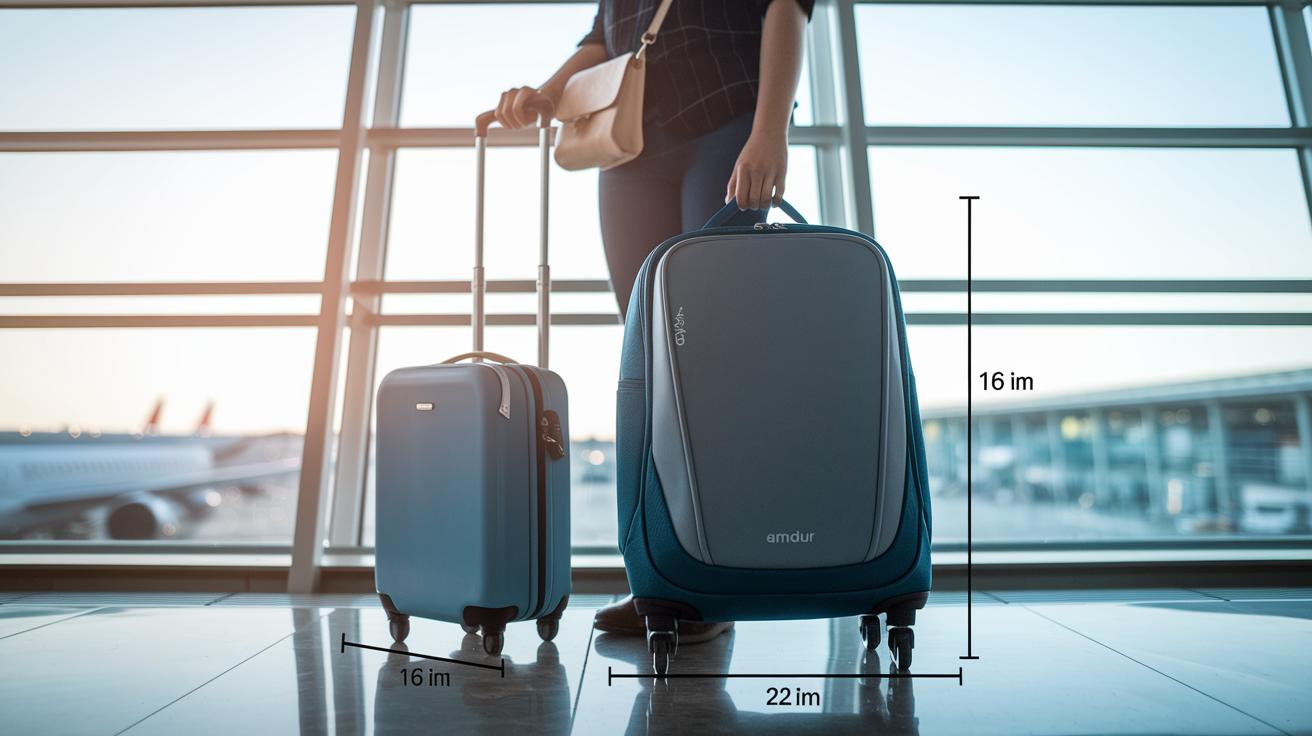
For short day trips, stick with a small personal item. A purse, briefcase, or compact backpack no larger than 17 x 10 x 8 inches is all you need to avoid checking a bag.
For one- to three-day getaways, a cabin bag that is up to 16 inches works great. It fits in overhead compartments and keeps packing simple. One traveler put it this way: "I packed a neat, compact bag perfect for a weekend trip, no hassle, no extra fees."
For trips lasting three to five days, choose a carry-on between 19 and 22 inches. This size gives you enough room for your essentials while staying within most airlines' rules. For longer journeys of six to ten days, go for medium checked luggage measuring 25 to 27 inches. Look for options like a medium two-wheel expandable brief or an expandable spinner for the right balance of space and convenience.
If you’re planning a trip of 10 to 12 days, a large checked case around 29 to 31 inches works best. And if you need extra space, like for ski gear or a relocation, consider an oversized bag over 31 inches, but keep in mind that extra fees may apply.
For more packing ideas, check out how to pack smart for international air travel.
Converting and Verifying Luggage Measurements: Inches to Centimeters
Check the guidelines above for converting your carry-on and personal items from inches to centimeters. Grab a tape measure and measure the bag’s outer dimensions, including the wheels and handles.
Variations in Airline-Specific Luggage Size Policies

Most U.S. airlines like American Airlines, Delta Air Lines, and United Airlines use a common carry-on size of 22″ x 14″ x 9″. This standard size helps you quickly see if your bag will fit in the overhead bin. Southwest, however, offers a little extra space, allowing bags up to 24″ x 16″ x 10″. Meanwhile, Frontier and Sun Country may accept bags slightly larger than the traditional size.
Across the Atlantic, European budget airlines set their own rules. For example, Ryanair usually limits cabin bags to 55 x 40 x 20 cm, while EasyJet sticks with a smaller 45 x 36 x 20 cm requirement. In the Middle East, carriers like Qatar have their own standard, with a carry-on allowance of 50 x 37 x 25 cm.
Checked baggage also differs by airline. Some airlines require the three dimensions of your bag to add up to no more than 158 cm and limit the weight to 30 kg. That means a bag that works as a carry-on on one flight might not be allowed as checked luggage on another route.
Before you travel, it's smart to measure your bag. Use a tape measure and check around wheels or handles to ensure you meet the airline’s guidelines.
| Airline/Region | Allowed Size |
|---|---|
| U.S. Standards (American, Delta, United) | 22″ x 14″ x 9″ |
| Southwest | 24″ x 16″ x 10″ |
| Ryanair | 55 x 40 x 20 cm |
| Qatar | 50 x 37 x 25 cm |
Tips for Measuring, Weighing, and Preventing Oversize Fees
Before you leave home, grab a flexible tape measure and check your bag's full size. Measure every part, including wheels and handles, to keep the total under 62 linear inches. Even a tiny extra inch can lead to oversize fees. One traveler mentioned that measuring twice, including the wheels, helped avoid gate-check charges.
Next, weigh your bag using a home scale to ensure it stays below 23 kg (50 lb). Overweight bags can cost extra, so it pays to check before heading to the airport. Taking a photo of your bag next to the scale can also serve as proof if any issues come up.
Finally, pack a foldable measuring tool in your travel kit. This handy gadget lets you quickly recheck your bag's size if you rearrange your items. And don’t forget to review your airline’s fee schedule before each trip, as rules can differ. Following these simple steps will help keep your travel smooth and stress-free.
Common Questions About Luggage Size Requirements

Q: Are there exceptions for oddly shaped bags or extra features?
A: Some airlines might allow a bit of extra size if the added inches come from hard parts like wheels or handles, as long as they don't prevent the bag from fitting in storage. Check your airline’s rules to be sure.
Q: Can slight oversizing ever be overlooked?
A: Yes, if the extra size comes from parts that don't bend easily, some carriers might allow it on a case-by-case basis. It helps to call customer service ahead of time to avoid any extra fees.
Q: What personal practices help avoid unexpected charges?
A: Always measure your bag after you finish packing. One traveler even said, "Measuring my bag after packing saved me from gate-check fees." This simple step can really keep you out of trouble.
Q: Do specialty items get different treatment?
A: Items like a golf bag or snowboard usually have their own set of rules. Make sure to check the airline’s guidelines before you travel to avoid surprises.
Final Words
In the action, this guide breaks down dimensions for carry-on, checked, and personal items. It explains standard sizes, offers conversion tips, and highlights airline differences that may affect your travel plans.
We share helpful measuring tips to avoid extra charges and optimize your packing. The advice here makes it easier to stay within allowed sizes and feel secure before each flight.
Keep this luggage size guide handy as you plan your next trip and enjoy a smoother travel experience.
FAQ
What are the standard luggage sizes in inches and centimeters?
The standard luggage sizes refer to a carry-on of about 22″ x 14″ x 9″ (56 x 36 x 23 cm), a personal item fitting within 17″ x 10″ x 8″ (43 x 25 x 20 cm), and checked bags that stay under 62 linear inches (157 cm).
What are the guidelines for checked baggage sizes?
The guidelines for checked baggage sizes require that the total dimensions (length+width+height) do not exceed 62 inches (157 cm). Medium checked cases measure roughly 24″–26″, while larger cases are about 27″–30″.
What is the Ryanair luggage size guide?
The Ryanair luggage size guide typically restricts cabin bags to around 55 x 40 x 20 cm. Passengers should review current policies, as restrictions often change and may differ from other airlines.
Are a 28-inch, 26-inch, or 24-inch suitcase considered large for checked luggage?
A 24-inch suitcase is common for standard trips, a 26-inch bag is viewed as medium-sized, and a 28-inch suitcase may be on the larger side, provided it complies with the airline’s total linear dimension requirements.
What is the standard suitcase size for most airlines internationally?
The standard suitcase size internationally is generally a carry-on around 22″ x 14″ x 9″ and checked baggage with a maximum of 62 linear inches (157 cm), though some airlines allow slight variations.